×
![]()
Working Hours
Monday to Friday: 09:00 AM – 06:00 PM Saturday–Sunday: ClosedContact Information
Republic of Armenia, Yerevan, 0025, 15 Charents Street Email:info@iae.am Phone:+37410-55-26-45Find us on Facebook
16-10-2025 09:00
 Presentation time will be limited to 20 minutes.
 Participation will be possible both online and in person.
 Selected papers will be considered for publication.
 For inquiries or further information, please contact the conference coordinators at: iae.anthropology@gmail.com
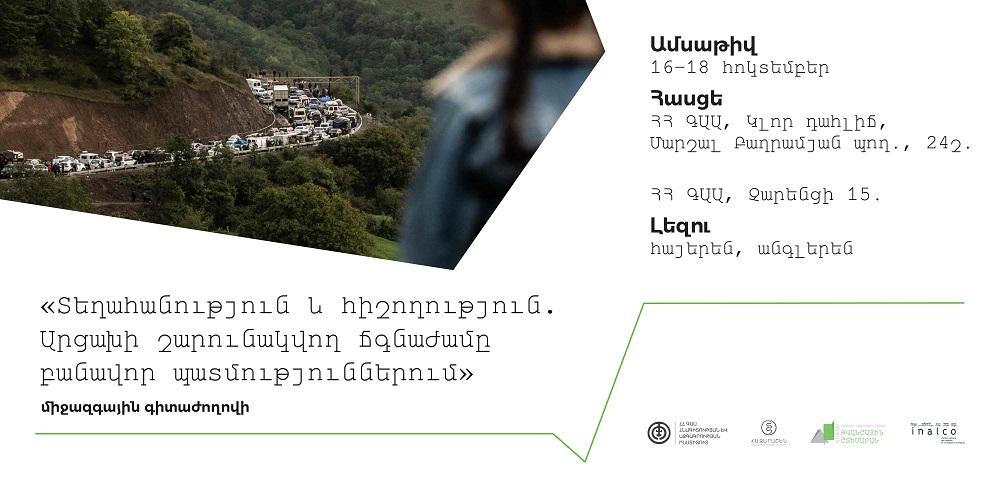
International Conference: Deportation and Memory: The Ongoing Crisis of Artsakh in Oral Histories
On the initiative of the Department of Cultural Anthropology and the Applied Anthropology Research Group of the Institute of Archaeology and Ethnography of the National Academy of Sciences of Armenia, together with the “Hazarashen” Armenian Center for Ethnological Studies and Inalco (Institut National des Langues et Civilisations Orientales, France), an international conference entitled “Deportation and Memory: The Ongoing Crisis of Artsakh in Oral Histories” will be held on October 16–17, 2025.
The aim of the conference is to examine how the war unleashed against Artsakh in 2020, the de facto siege of Artsakh, and the mass deportation of its population—planned during 2020–2023 and carried out in September 2023—have been represented and interpreted in the Armenian and international media, in the public sphere, and transmitted through oral histories. The discussion will address not only the content and informational layers of memory, but also the means and forms of its transmission, the bearers of memory, and the politics surrounding war, displacement, and memory formation, as well as the social and cultural consequences.
While the primary focus of the conference is the current crisis in Artsakh, given the region’s geographical position and the complex historical trajectories of its population’s identities, the program will also be open to exploring historical contexts of Artsakh’s crises and their reflection in contemporary public, scholarly, and political discourses.
Proposed presentations may address, but are not limited to, the following topics:
1. Episodes from the history of crises in Artsakh: causes, manifestations, consequences, and their reflection in modern scholarly and public discourses:
a) 16th–17th centuries: The period of Qizilbash Persia
b) 18th–19th centuries: Crises during the 70 years of the Karabakh Khanate
c) 19th century: Artsakh under the Russian Empire; the population and the transformation of its class structure
d) 20th century: Artsakh under the Musavat regime of Azerbaijan
e) 20th century: The Bolshevik and Soviet periods; attempts by the people of Artsakh to draw government attention to their problems
f) 20th century: The USSR’s policy of “internationalism” in Artsakh
g) 20th century: A closed society within a closed society—knowledge about Artsakh in Artsakh, the Caucasus, and the USSR (sources and channels of transmission)
h) 20th century: Mobilization processes of Artsakh’s civic and ethnic units in times of crisis
2. The 30-year history of the unrecognized Republic of Artsakh: wars, displacement, and deportation
3. Besieged Artsakh in information sources and oral histories
4. Politics of memory and forgetting: official narratives and texts of power
5. Oral narratives of the people of Artsakh as a research method and as an alternative to official historiography
6. The USSR’s politics of memory with regards to the Artsakh/Karabakh question
7. Knowledge about the Sumgait massacres in Armenia, Azerbaijan, Georgia, the Caucasus, the USSR, and post-Soviet republics
8. Oral histories of the Artsakh deportation: methodological and ethical issues
9. Comparative examination of the terminology of threat, deportation, displacement, and genocide (the case of Artsakh)
10. Tangible cultural heritage of Artsakh and the challenges of its preservation
11. Intangible cultural heritage of Artsakh
12. Everyday life and social organization of forcibly displaced persons
13. Materiality and carriers of memory (photo archives, objects, etc.)
14. Digital platforms and the archiving of memory
15. Gender perspectives in memory studies
16. Memory and trauma—collective and individual
17. Representation of displacement memory in the arts and literature
18. Comparative cases: forced displacements and their remembrance in other countries
19. Sites of memory and rituals of commemoration in Artsakh
20. “Artsakh’s memory and history” in the educational system
21. Processes of forced displacement and redefinition of identity
22. Memory as a means of resistance and identity preservation
The conference is open to researchers from academic institutions, independent scholars, and postgraduate students.
Those wishing to participate should submit the title of their presentation in both Armenian and English, along with an abstract of up to 300 words (in Armenian or English), by September 15, 2025 to: iae.anthropology@gmail.com
An individual application form must also be completed: https://forms.gle/9tqFppheHr8KXRVA8
The working languages of the conference are Armenian and English.
Applicants will be notified of the selection results by September 25, 2025.
Presentation time will be limited to 20 minutes.Participation will be possible both online and in person.Selected papers will be considered for publication.For inquiries or further information, please contact the conference coordinators at: iae.anthropology@gmail.com Organizing Committee:
Levon Abrahamian
Hranush Kharatyan
Anaid Donabedian-Demopoulos
Gayane Shagoyan
Lusine Kharatyan
The program:
https://www.dropbox.com/scl/fi/8ah26ggxoulkygp9gt93l/Program-Displacement-and-Memory.pdf?rlkey=rzut6mvl2k5ldda4ujtkgl48r&e=1&dl=0
