Working Hours
Monday to Friday: 09:00 AM – 06:00 PM Saturday–Sunday: ClosedContact Information
Republic of Armenia, Yerevan, 0025, 15 Charents Street Email:info@iae.am Phone:+37410-55-26-45Find us on Facebook
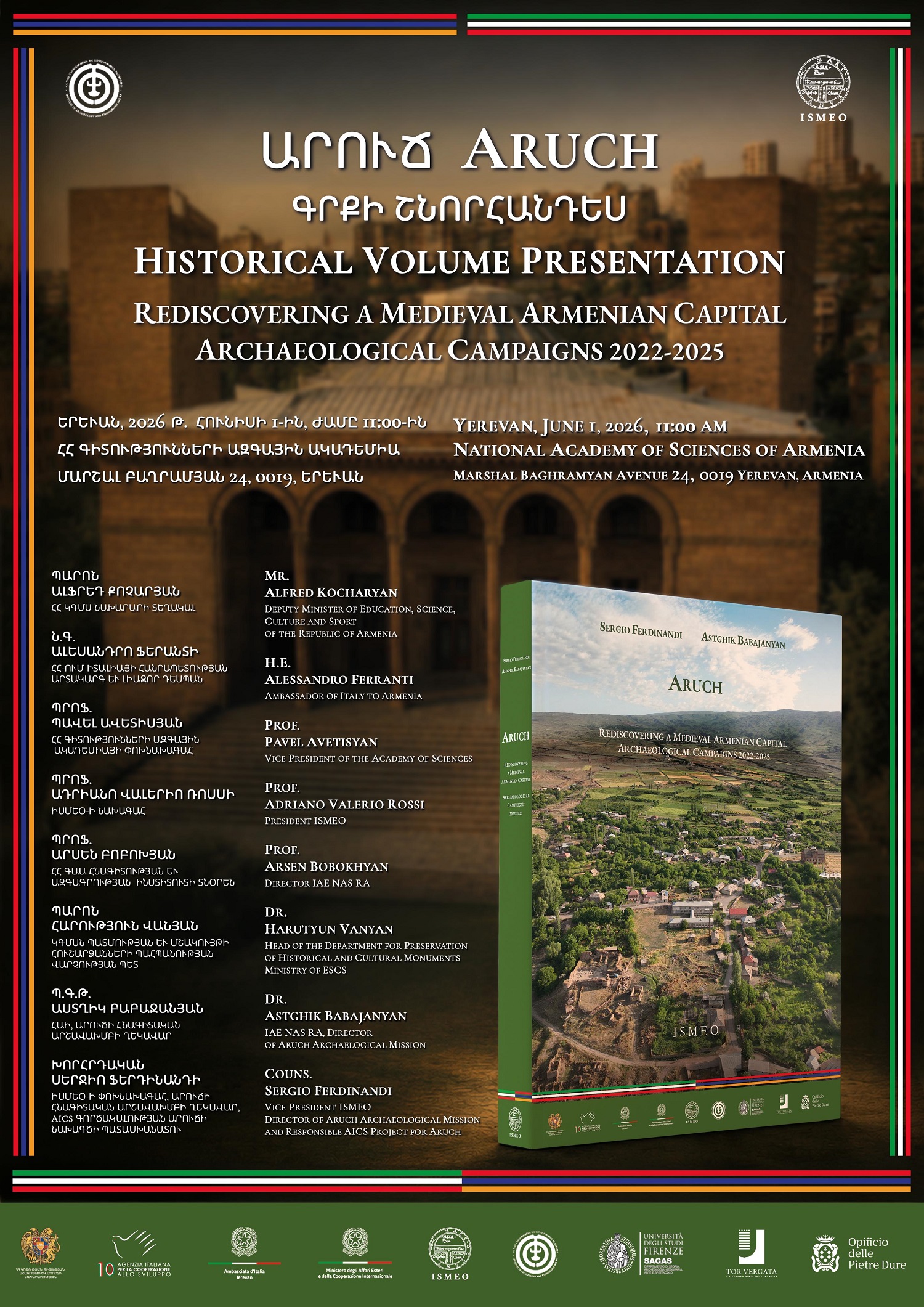
Presentation of the volume “Aruch: Rediscovering a Medieval Armenian Capital (Archaeological Campaigns 2022–2025)”
On June 1, 2026, at 11:00, the presentation of the volume “Aruch: Rediscovering a Medieval Armenian Capital (Archaeological Campaigns 2022–2025)” will take place in the Round Hall of the Presidium of the National Academy of Sciences of the Republic of Armenia (24 Baghramyan Avenue, Yerevan).
Welcoming remarks will be delivered by:
- Alfred Kocharyan, Deputy Minister of Education, Science, Culture and Sports of the Republic of Armenia
- H.E. Alessandro Ferranti, Ambassador of Italy to Armenia
- Pavel Avetisyan, Vice President of the National Academy of Sciences of the Republic of Armenia
- Adriano Valerio Rossi, President of ISMEO
- Arsen Bobokhyan, Director of the Institute of Archaeology and Ethnography, NAS RA
- Harutyun Vanyan, Head of the Department for the Preservation of Historical and Cultural Monuments, Ministry of ESCS RA
The volume will be presented by:
- Astghik Babajanyan, Institute of Archaeology and Ethnography, NAS RA; Director of the Aruch Archaeological Expedition
- Sergio Ferdinandi, Vice President of ISMEO; Director of the Aruch Archaeological Expedition; Responsible AICS Project for Aruch
This new scholarly volume, dedicated to the medieval historical and cultural heritage of Aruch, presents the results of four years of Armenian–Italian archaeological collaboration. It offers a comprehensive reassessment of the site as a major political, cultural, and economic center of medieval Armenia.
The study focuses on the medieval fortress within its broader architectural and cultural landscape, reconstructing its spatial organization, functional zones, and long-term patterns of occupation, reuse, and transformation from the Middle Ages to the Early Modern period. It emphasizes that Aruch, combining religious and secular authority and supported by a developed fortification and infrastructure system, was not merely a settlement or road stop, but a multifunctional and dynamic centre of medieval life.
The second section of the volume addresses cultural heritage as a sustainable driver of rural development. It presents ongoing programs for the preservation, restoration, and valorization of Aruch, with the aim of integrating archaeological research into heritage management strategies and advancing the creation of an eco-archaeological park.
