Events
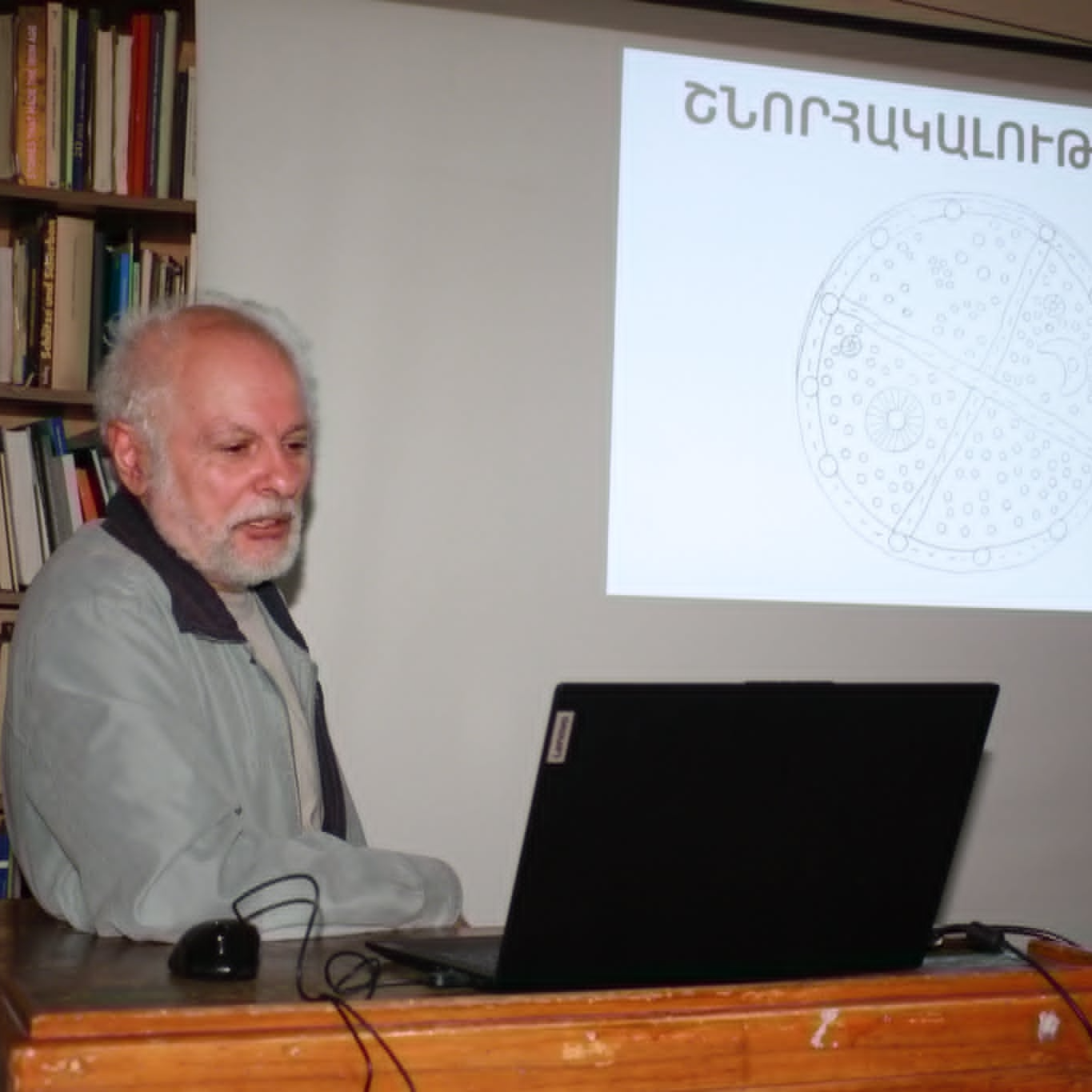
Lecture: “Concepts of Space and Time in the Rock Art of Armenia”
On May 21, a lecture entitled “Concepts of Space and Time in the Rock Art of Armenia” was held in the reading hall of the Institute of Archaeology and Ethnography of the NAS RA within the framework of the “Folkloristic Discussions” series. The event was dedicated to the recently published monograph “The Rock Art of Armenia” by Karen Tokhatyan, PhD, and was organized by the Department of Folk Studies of the Institute, featuring a presentation by the author himself. The event was attended by staff members from various departments of the Institute of Archaeology and Ethnography, as well as individuals interested in the topic. The speaker was introduced by Tork Dalalyan, Deputy Director of the Institute of Archaeology and Ethnography, who emphasized the significance of the publication devoted to the rock art of Armenia and highlighted the author’s important and long-term scholarly work. K. Tokhatyan presented excerpts from the monograph and discussed rock art found both in Armenia and in various parts of the world, many examples of which date back millennia. During and after the lecture, attendees addressed questions to the speaker, followed by a discussion.
2026-05-21
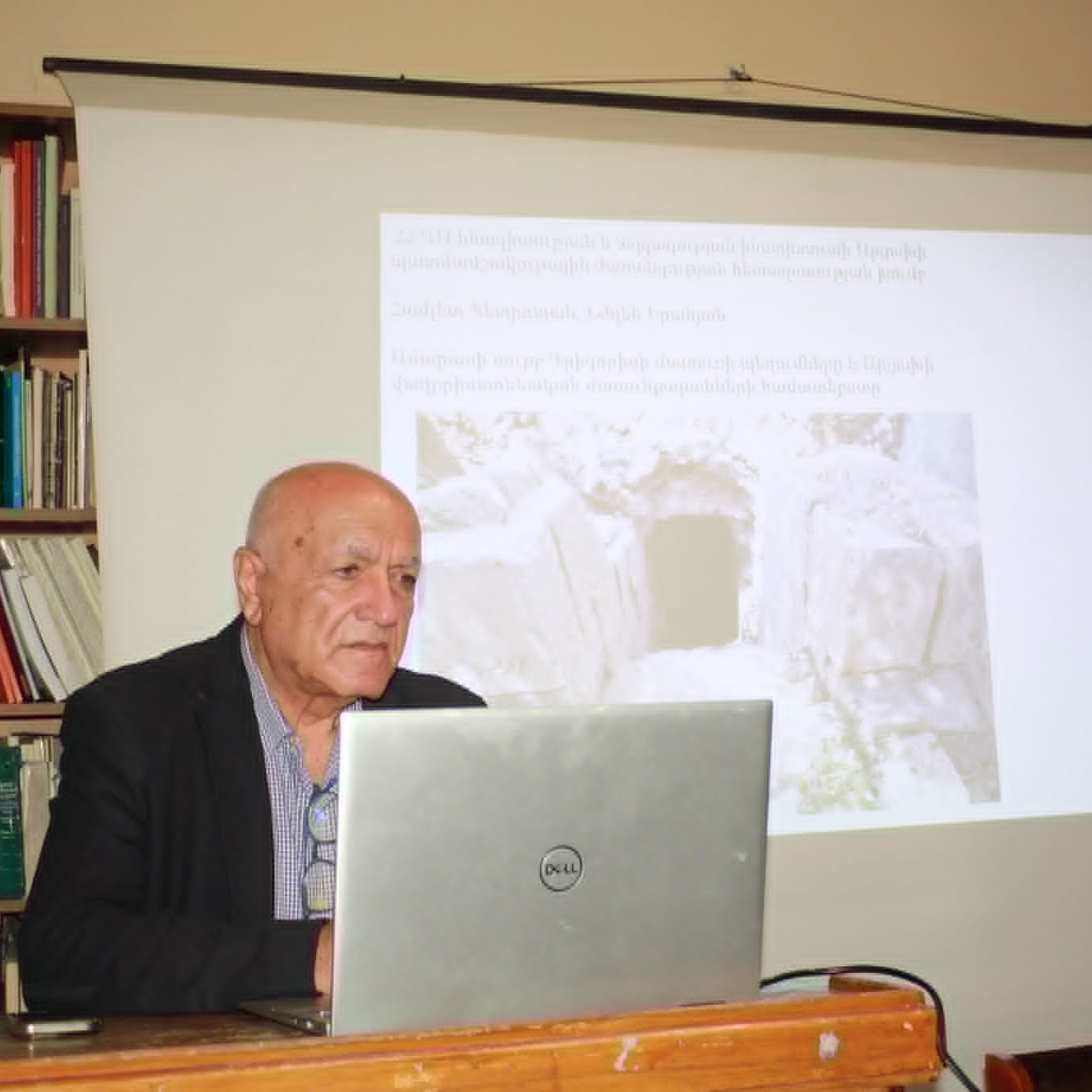
Lecture: “The Excavations of the St. Grigoris Chapel of Amaras and the Context of Early Christian Reliquaries in Artsakh.”
On May 18, the regular seminar of the Research Group for the Historical and Cultural Heritage of Artsakh was held in the reading hall of the Institute of Archaeology and Ethnography of the NAS RA. Prof. Hamlet Petrosyan, Doctor of Historical Sciences, delivered a lecture entitled “The Excavations of the St. Grigoris Chapel of Amaras and the Context of Early Christian Reliquaries in Artsakh.” The excavations of the St. Grigoris Chapel of Amaras, located in the Martuni region of the Republic of Artsakh, were carried out in the eastern courtyard of the present-day church, within a separate 6×5 m excavation area adjoining the exterior side of the eastern wall. The principal aim was to verify the hypothesis according to which the current church, by means of its eastern wall, had cut through and divided the chapel into two parts, leaving its presumed eastern entrance outside the structure. The speaker noted that the excavations revealed the remains of the eastern entrance constructed of finely hewn stones, including the open-air vestibule, the bases of the monumental entrance, a wall pilaster base, as well as the staircase descending into the semi-subterranean hall. The excavations also demonstrated that the original structure of Grigoris’s tomb possessed an eastern entrance, an exceptional phenomenon in Armenian ecclesiastical architecture. The speaker further noted that during the long-term excavations conducted at Tigranakert, a tomb with an eastern entrance was likewise uncovered within the area of the early Christian church discovered there. During the lecture, H. Petrosyan also addressed the activities of King Vachagan and a number of related issues. During and after the seminar, attendees addressed questions to the speaker, followed by a professional discussion.
2026-05-18
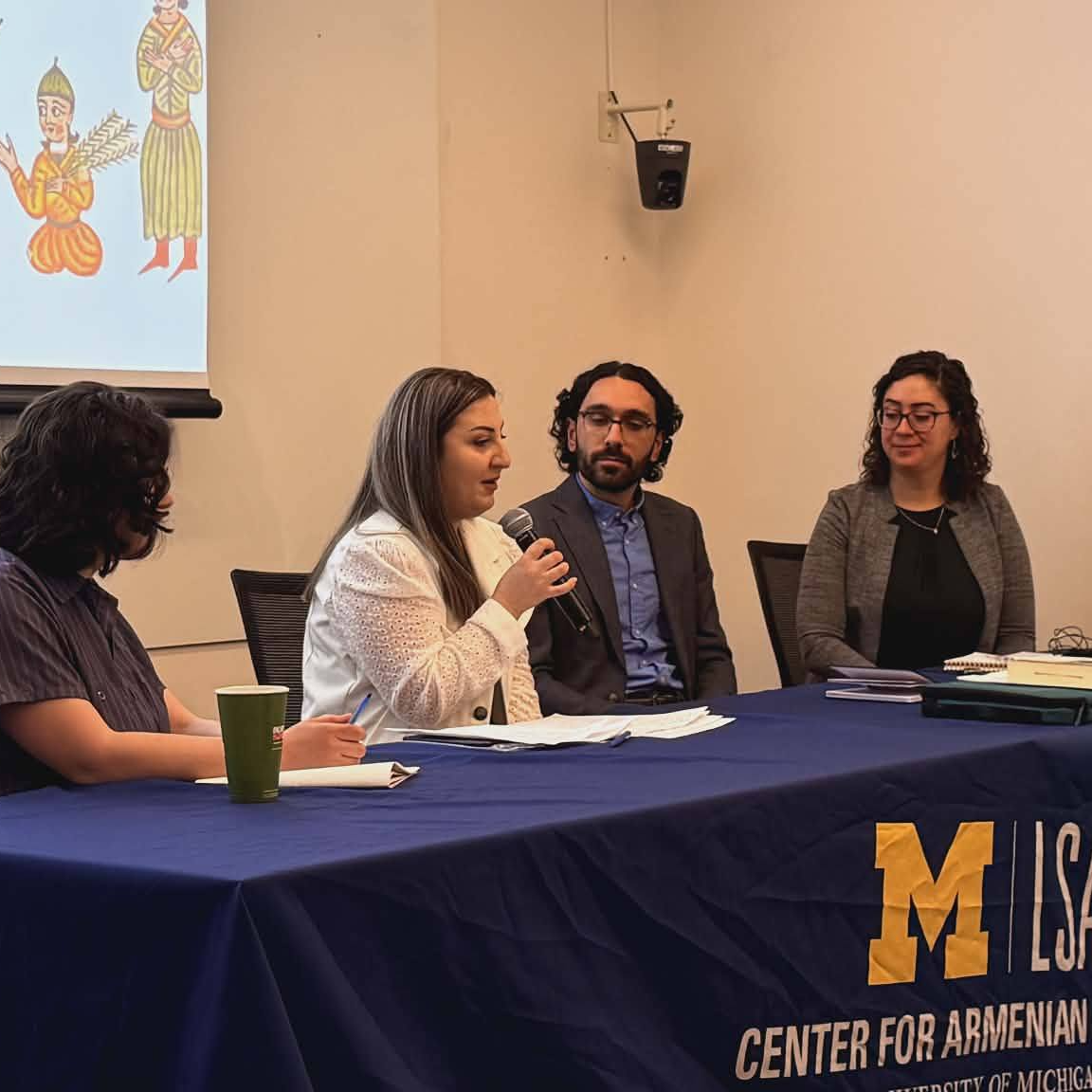
Lusine Tanajyan at the 15th Workshop of the Armenian Studies Program at the University of Michigan
On April 9–11 of this year, Lusine Tanajyan, PhD in History, Senior Researcher at the Department of Diaspora Studies, participated in the 15th International Workshop organized by the Center for Armenian Studies at the University of Michigan (Ann Arbor, USA). Within the framework of the workshop, Dr. Lusine Tanajyan delivered a presentation on issues of identity among Armenians in Greece. The event brought together leading scholars in Armenian and diaspora studies, as well as researchers from various countries, creating a productive environment for in-depth academic discussions and exchange of ideas.
2026-05-06
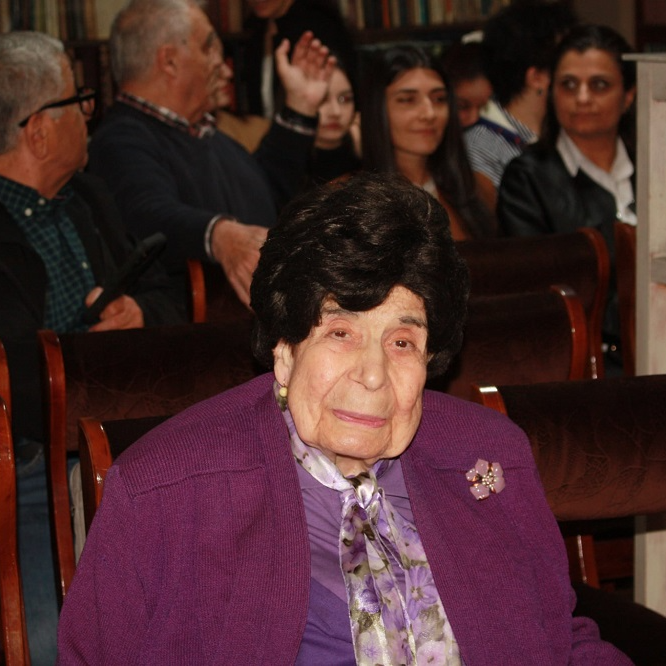
OLecture entitled “The Forced Turkification of Western Armenians in the Ottoman Empire and Turkish-Language Folklore (Based on Materials Recorded and Collected by Me in 1955–2025)”, dedicated to the 111th anniversary of the Armenian Genocide
On April 23, on the eve of the 111th anniversary of the Armenian Genocide, a lecture entitled “The Forced Turkification of Western Armenians in the Ottoman Empire and Turkish-Language Folklore (Based on Materials Recorded and Collected by Me in 1955–2025)” was delivered at the Institute of Archaeology and Ethnography of the NAS RA by Doctor of Philological Sciences Verjine Svazlian. The lecture was organized within the framework of the Institute’s “Folklore Studies Discussions” series. It was attended by staff members from various departments of the Institute, students, and others interested in the topic. The audience was welcomed and the speaker introduced by the Deputy Director of the Institute, Tork Dalalyan, who noted that it was an honor to host the long-standing, dedicated, and distinguished researcher Verjine Svazlian, whose 90th anniversary had been celebrated at the Institute two years earlier. He added that the Institute maintains continuous contact with the scholar, who, during each visit, brings copies of her newly published books. Through her own example, Verjine Svazlian demonstrates that approaching one’s beloved work with dedication and enthusiasm makes it possible to accumulate a substantial body of scholarly material. At present, she already has approximately 900 pages of material prepared for her forthcoming book. T. Dalalyan also emphasized the importance of involving the younger generation, particularly students, stressing that interaction with and acquaintance with such scholars can serve as a source of inspiration and creative motivation. V. Svazlian began her lecture by recalling to the period of the formation of the Ottoman Empire and the subsequent anti-Armenian and genocidal policies pursued by Turkey, as well as those directed against other peoples. She also addressed works written in Turkish but using the Armenian script, which emerged under conditions of Turkish domination. In the second part of the lecture, V. Svazlian presented recordings of songs she had collected, including lullabies, war songs, and other folklore materials performed in Turkish by Armenian singers. the end of the lecture, the audience posed questions to the speaker, followed by a discussion.
2026-04-23
Results of the 2025 Excavations: 12 Reports Presented on April 3
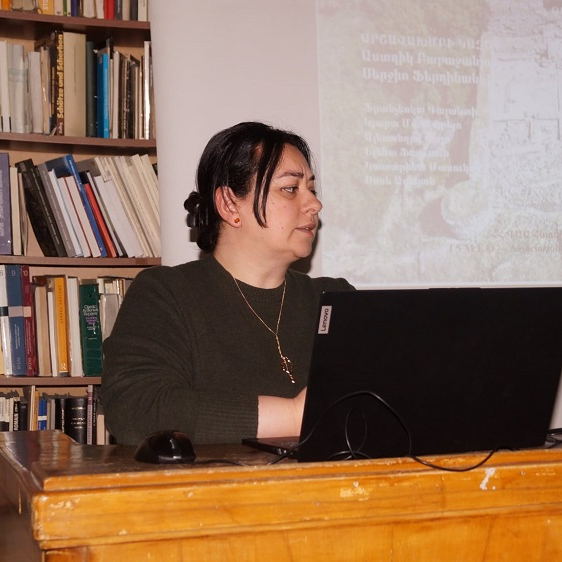
On April 1–3, 2026, presentations of reports on archaeological surveys and excavations conducted in 2025 were held in the reading hall of the Institute of Archaeology and Ethnography of the National Academy of Sciences of the Republic of Armenia (IAE NAS RA). Over the course of three days, a total of 36 reports were presented, covering research carried out in various regions of the Republic of Armenia as well as in Yerevan. The presentations were attended by the Director of the IAE NAS RA, Arsen Bobokhyan, members of the Institute, students, and guests. On April 3, twelve reports were presented. The session was chaired by Astghik Babajanyan, Senior Researcher and Scientific Secretary of the IAE, who also delivered a separate presentation. She presented the results of the 2025 investigations and excavations carried out at the Aruch fortress complex. The site was in use from approximately the 5th century AD until the 13th–14th centuries, as well as in the 20th century. The work was conducted within the framework of the project “Medieval Fortifications along the Silk Road.” Archaeologist Simon Hmayakyan, Senior Researcher of the IAE, PhD, addressed the archaeological excavations carried out at the historical site of Argishtikhinili in Armavir Province, as well as in the cemetery and rural settlement of the same name. Archaeologist Inessa Karapetyan, PhD, presented the archaeological investigations and excavations conducted in 2025 at the ancient city of Old Armavir in Armavir Province. The report by Syuzanna Muradyan concerned the work carried out at the site of Yervandashat in the Baghramyan community of Armavir Province. Mkrtich Zardaryan, PhD, head of the expedition conducting excavations at the historical capital of Artashat and at the site of “Klor Blur” near the village of Akunk in Gegharkunik Province, presented noteworthy data on both sites. Doctor of Historical Sciences, Professor Hamlet Petrosyan presented information on archaeological investigations and excavations carried out in the territory of the historical capital of Dvin, as well as at the nearby site of Tiknuni. In 2025, reconnaissance archaeological surveys were also conducted in Kond district of Yerevan, where, according to certain data, the presence of remains of a fortress from the Urartian period had been hypothesized. The work was carried out by Hamlet Petrosyan and archaeologist Hamazasp Abrahamyan. The report by archaeologist Gagik Sargsyan concerned two sites in Syunik Province: the Syunik capital Kapan and Vanandaberd.
2026-04-06
Lecture at the IAE titled “Interregional Anecdotes (Humorous story) among the Armenian Refugee Community of Aleppo.”
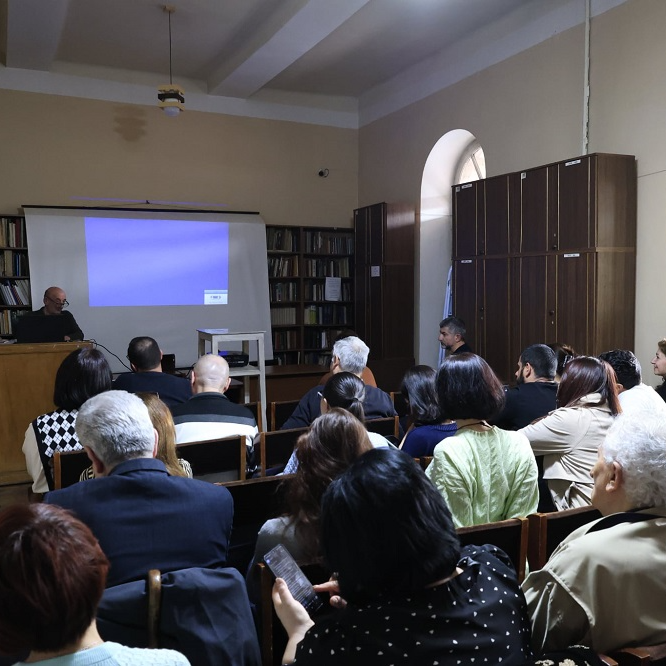
On March 19, the Folklore Department of the Institute of Archaeology and Ethnography (IAE) of the National Academy of Sciences of the Republic of Armenia organized a regular lecture. Within the framework of the “Folklore Discussions” series, a lecture titled “Interregional Anecdotes (Humorous story)among the Armenian Refugee Community of Aleppo” was held at the IAE reading hall. The lecture was delivered by Doctor of Historical Sciences Hakob Cholakyan. The event was attended by staff members from various departments of the Institute, as well as individuals interested in the topic and students. The Deputy Director of the IAE, Tork Dalalyan, introduced the speaker, emphasizing the importance of organizing such academic meetings and their role in fostering professional dialogue. At the end of the lecture, an active discussion took place. The attendees asked questions and shared their observations and suggestions.
2026-03-20
