Events

A Presentation of the Book “The Fortresses of Syunik: 9th–14th Centuries” Was Held at the Institute of Archaeology and Ethnography.
n 24 June, the Library of the Institute of Archaeology and Ethnography of the National Academy of Sciences of the Republic of Armenia hosted the presentation of an important scholarly publication. In 2026, architect Ara Zarian's comprehensive and richly illustrated monograph, The Fortresses of Syunik: 9th–14th Centuries, comprising 86 printer's sheets, was published in an edition of 150 copies. The volume is devoted to the medieval fortresses of the historical province of Syunik in Greater Armenia. It was published upon the recommendation of the Academic Council of the Alexander Tamanyan National Museum-Institute of Architecture and issued by the AGBU Vahram Abtalian Cultural Foundation. The foreword was written by Professor Ashot Haykazun Grigoryan, Doctor of Architecture. The publication consists of a foreword, the author's preface, and six main chapters that provide a comprehensive examination of the medieval fortresses and fortified architectural heritage of Syunik. The presentation was attended by staff members from various departments of the Institute of Archaeology and Ethnography, as well as numerous invited guests. The audience was welcomed by the Institute's Director, Arsen Bobokhyan, Doctor of Historical Sciences. Emphasizing the scholarly and cultural significance of the monograph, he outlined the author's professional career and expressed his appreciation for Ara Zarian's many years of dedicated work. The author also addressed the audience, noting that his interest in the fortresses of Syunik dates back to his student years at the Yerevan Polytechnic Institute, inspired and encouraged by his late father, the architect Armen Zarian. T he presentation concluded with a question-and-answer session and an engaging discussion, during which participants had the opportunity to address both the contents of the volume and current issues in the study of Syunik's fortified architectural heritage.
2026-06-24
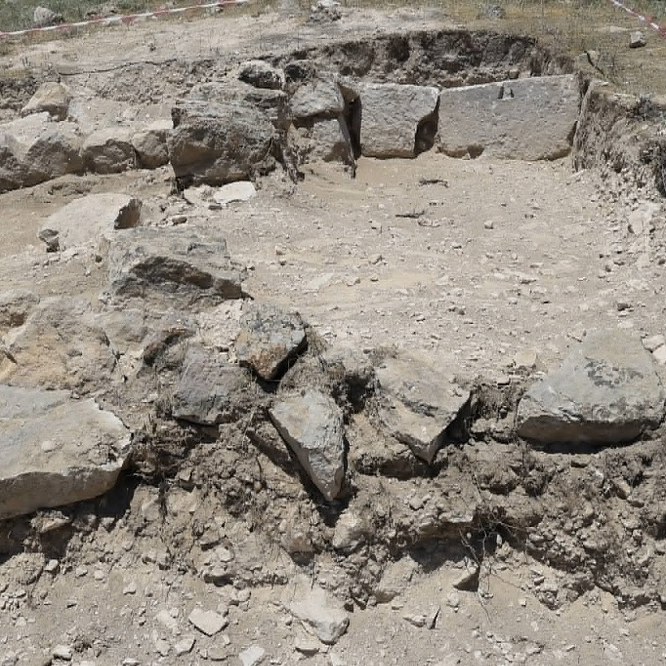
Excavations at a Newly Discovered Archaeological Site Near Vedi
Recently, archaeological investigations and excavations were carried out at a newly discovered archaeological site located near the town of Vedi in Armenia’s Ararat Province under the direction of Armine Gabrielyan, Senior Researcher at the Institute of Archaeology and Ethnography of the National Academy of Sciences of the Republic of Armenia, Ph.D. The site is situated between the villages of Dashtakar and Urtsadzor, approximately 3 km east of Vedi. On the final day of the excavations, we had the opportunity to visit the site and become acquainted with the work carried out there. According to Armine Gabrielyan, the first reconnaissance survey of the area was conducted in May 2022, accompanied by a resident of Vedi who informed the researchers about the presence of jar burials at the location. “Looters’ pits were already clearly visible on the two hills of the site, and they remain there to this day,” the archaeologist notes. The reconnaissance survey established that traces of architectural structures were present on both hills, while large quantities of painted pottery sherds dating to the Classical period were observed on the surface. As part of the short-term excavations conducted in May–June 2026, a 14 × 10 m trial trench was opened. The excavations revealed double-faced walls measuring 1.30–1.50 m in width, with a core filled with smaller stones. With only slight deviations from the cardinal directions, these walls are generally oriented along the north–south and east–west axes. Within the exposed structure, a stone-cist burial of a child dating to the same period was discovered and excavated. Among the noteworthy finds are several finely dressed stones bearing traces of dovetail joints. These, however, were found in secondary use and had been incorporated into the funerary structure. Armine Gabrielyan adds: “The 2026 excavations also have a rescue component to a certain extent. Our objective is to document and reveal the archaeological and cultural context of the site as comprehensively as possible, as it is being damaged on a daily basis by illegal excavations carried out by looters in the area.” The expedition's architect is Hayk Kyureghyan, and residents of the town of Vedi are also participating in the fieldwork. The research team plans to continue the excavations in the near future by expanding the boundaries of the excavation area and further advancing the investigation of this newly discovered archaeological site.
2026-06-15
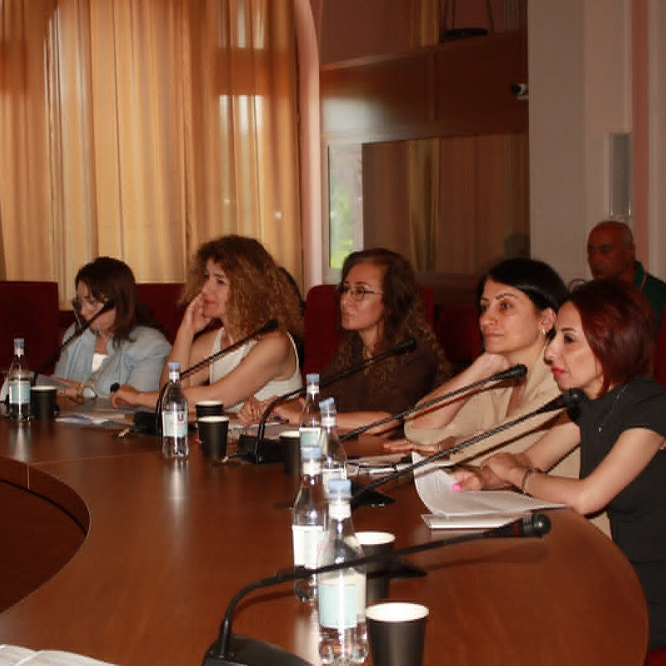
On June 12, the two-day conference entitled “Festival and Festive Culture as a Culture-Shaping Text of the Past and Present” opened
On June 12, the two-day conference entitled “Festival and Festive Culture as a Culture-Shaping Text of the Past and Present” opened in the Round Hall of the National Academy of Sciences of the Republic of Armenia (NAS RA). The conference was organized within the framework of the targeted research project “The Use of Manifestations of Traditional Cultural Heritage in Politics: Opportunities and Recommendations,” implemented by the Institute of Archaeology and Ethnography of the NAS RA. The conference brought together representatives of various scientific institutions of the Republic of Armenia and higher educational institutions operating in Yerevan. The presentations were devoted to the Armenian traditional festive calendar, the historical and contemporary manifestations of festive culture, as well as the study of the festival as a means of expressing ethnic, religious, social, civic, and political identity. Particular attention was paid to issues related to the festive calendar, the politics of memory, intangible cultural heritage, the festivalization of celebrations, their use as public events, transformations in the digital environment, and their relationship with the creative industries. The first day of the conference included three sessions, each featuring five presentations of approximately 20 minutes each. Every session concluded with a question-and-answer period and discussion. The participants were welcomed by Pavel Avetisyan, Vice President of the NAS RA, who emphasized the importance of the conference and wished it every success. Welcoming remarks were also delivered by Hranush Kharatyan, Head of the Applied Anthropology Group at the Institute of Archaeology and Ethnography, who highlighted the conference's relevance and noted that it would be followed directly by a two-day workshop to be held in the same venue. The first session, entitled “Festival and Festivity in Armenian Historiography,” was chaired by ethnographer and Doctor of Historical Sciences Harutyun Marutyan. After the break, the second session, “The Cultural Text of the Festival in the Folk Tradition of the 19th Century,” was chaired by Ruzanna Tsaturyan. The third session, “The ‘Arrival’ of the Soviet Festival: New Culture-Shaping Texts in Soviet Armenia and the Armenian Diaspora,” was chaired by Haykuhi Muradyan, lecturer at Yerevan State University and researcher at the Institute of Archaeology and Ethnography. She also presented the paper “The Institutionalization of Soviet Festive Culture and Its Performative Manifestations in Houses of Culture (Soviet Armenia, 1950s–1980s).” The second day of the conference is scheduled to include four additional sessions. Following the conclusion of the conference, on June 14–15, a workshop will be held at the same venue. It is likewise organized within the framework of the targeted research project “The Use of Manifestations of Traditional Cultural Heritage in Politics: Opportunities and Recommendations.”
2026-06-12
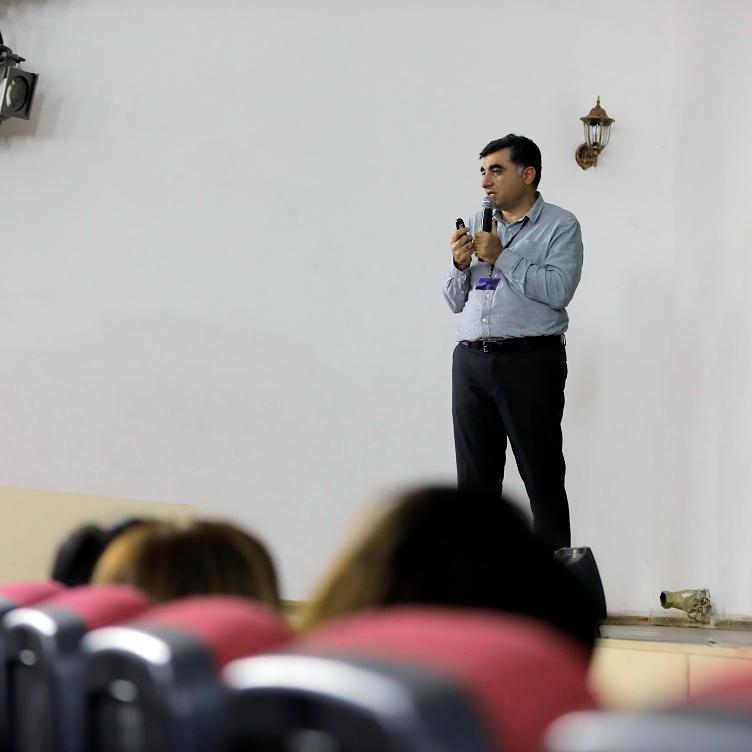
Dragon Stones Come Alive for a New Generation: The “Guardians of the Dragon Stones” Educational Campaign Has Begun
The Institute of Archaeology and Ethnography (IAE) of the National Academy of Sciences of the Republic of Armenia, the NGO Culture as a Factor, and the OnOff Animation Studio have launched a series of regional events as part of the educational and cultural project “Guardians of the Dragon Stones.” Following the official premiere held on May 27 at the Moscow Cinema in Yerevan, the project's scientific and creative team has already visited the communities of Armavir, Hrazdan, Charentsavan, Yeghvard, and Abovyan. What is the Institute’s role? As the country's leading scientific center in the field, the Institute of Archaeology and Ethnography provides the project's academic foundation and ensures its scientific accuracy. With the guidance of our specialists, all information about the dragon stones has been aligned with the latest archaeological excavation data. Through interactive talks led by the Director of the Institute, Arsen Bobokhyan, young participants gain archaeological knowledge and become informed guardians of our cultural heritage. What to expect at each event: Screening of the animated short film “The Dragon and Vahagn”, based on Artavazd Yeghiazaryan’s book The Secret of the Dragon Stone. An interactive scientific talk on the mysteries of the dragon stones and the latest archaeological discoveries with Arsen Bobokhyan. Presentation of a brand-new song specially composed for the project by the band Tiezerk. Educational gift: Every young participant will receive the project's special interactive booklet. Upcoming schedule: ???? June 11 – Ashtarak and Aparan ???? June 16 – Sevan and Gavar ???? June 18 – Etchmiadzin Special prize for active participants After the completion of the regional meetings, three interactive digital quests will be launched on social media platforms. Participants achieving the best results will have the opportunity to join an exclusive one-day scientific expedition to visit real dragon stones under the guidance of professional archaeologists. Admission is free, but due to limited seating, advance registration is required. The registration link and additional details are available in the comments. Registration link: https://docs.google.com/forms/d/e/1FAIpQLSetH5yfAOjdXKM0OjvBMMUfvG5cKde0mkv0WHYvjlyxsqP8SA/viewform The project is implemented with the support of the H. Hovnanian Family Foundation and the Ministry of Education, Science, Culture and Sports of the Republic of Armenia. The production of the film screened within the framework of the project was also supported by the Armenian Film Foundation.
2026-06-11
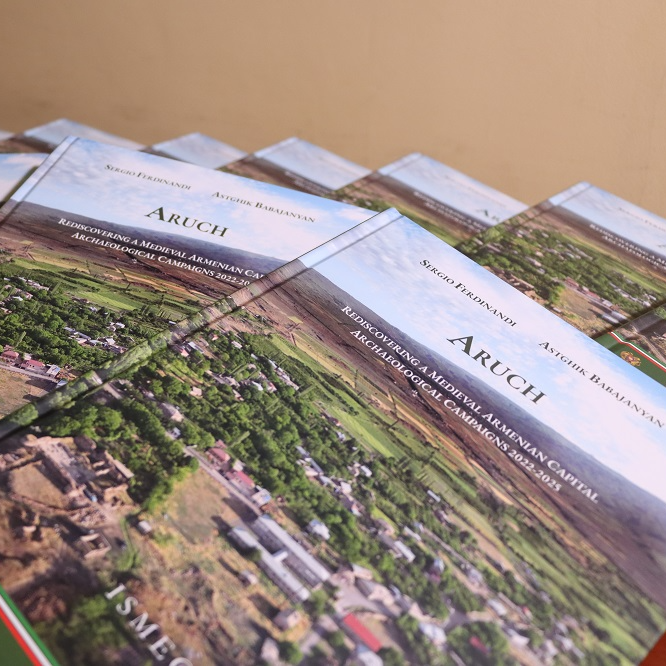
The presentation of the volume "Aruch. Rediscovering a Medieval Armenian Capital (Archaeological Campaigns 2022–2025)".
On June 1, the Round Hall of the Presidium of the National Academy of Sciences of the Republic of Armenia hosted the presentation of the volume "Aruch. Rediscovering a Medieval Armenian Capital (Archaeological Campaigns 2022–2025)". Archaeological excavations at the fortress of Aruch village were conducted by the Armenian–Italian archaeological mission, and the results of these investigations have now been published in this important scholarly work. Among those attending the event were Alessandro Ferranti, Ambassador Extraordinary and Plenipotentiary of the Italian Republic to Armenia; Academician Yuri Suvaryan; Pavel Avetisyan, Vice-President of the National Academy of Sciences of the Republic of Armenia; Valerio Rossi, President of ISMEO; Arsen Bobokhyan, Director of the Institute of Archaeology and Ethnography of the NAS RA; as well as archaeologists, historians, members of the expedition, and invited guests. The opening remarks were delivered by Arsen Bobokhyan, Director of the Institute of Archaeology and Ethnography, who emphasized the significance of the research and excavations carried out by the Armenian–Italian archaeological mission, as well as the publication of the volume summarizing their results. Greetings were also delivered by Alessandro Ferranti, Ambassador Extraordinary and Plenipotentiary of the Italian Republic to Armenia. Pavel Avetisyan, Vice-President of the NAS RA, highly praised both the scholarly importance of the publication and the Armenian–Italian cooperation in the field of archaeology. He also noted that Italian archaeologists are currently collaborating with their Armenian colleagues on archaeological investigations at Dvin under the direction of archaeologist Hamlet Petrosyan, as well as at other archaeological sites. Valerio Rossi, President of ISMEO, likewise highlighted the importance of the Armenian–Italian archaeological mission and the value of the newly published volume. The book was presented by its co-authors: Astghik Babajanyan, Scientific Secretary of the Institute of Archaeology and Ethnography of the NAS RA and Co-Director of the Aruch Archaeological Mission, and Sergio Ferdinandi, Vice-President of ISMEO, Co-Director of the Aruch Archaeological Mission, and Coordinator of the Aruch Project of the Italian Agency for Development Cooperation (AICS). The new scholarly volume dedicated to the medieval historical and cultural heritage of Aruch presents the results of four years of Armenian–Italian archaeological collaboration and offers a comprehensive reassessment of the site as an important political, cultural, and economic centre of medieval Armenia. The study focuses on the medieval fortress, examining it within the broader built and cultural landscape of Aruch. The authors reconstruct its architectural layout, functional spaces, and the long sequences of occupation, reuse, and transformation extending from the medieval period into the Early Modern era. The research demonstrates that Aruch, combining the functions of both religious and secular centres of authority and possessing a developed system of fortifications and infrastructure, was not merely a settlement or a stop along communication routes, but a vibrant and multifunctional centre of medieval life. The second part of the volume is devoted to the role of cultural heritage as a key driver of sustainable rural development. It presents the ongoing programmes for the conservation, restoration, and promotion of Aruch, aiming to integrate archaeological research into broader processes of heritage management and the development of an eco-archaeological park.
2026-06-01
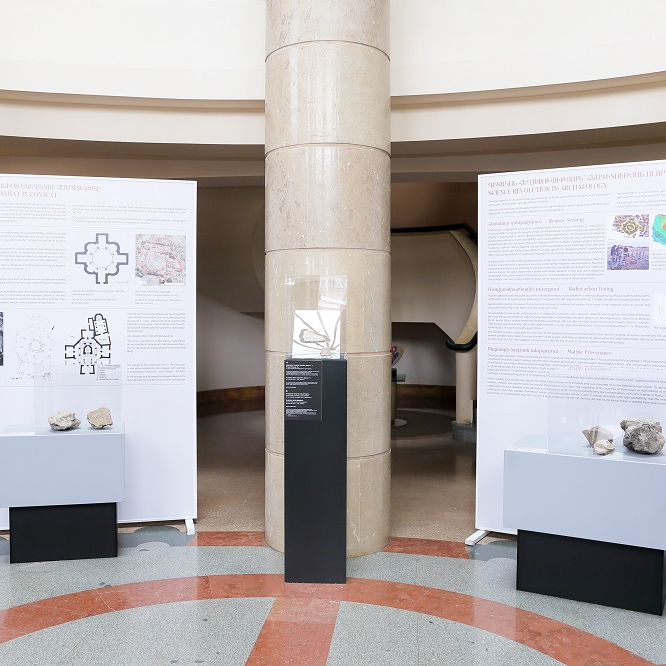
A temporary exhibition entitled “Aruch: Rediscovering A Medieval Armenian Capital Archeological Campaigns 2022-2025 ” opened.
On May 29, a temporary exhibition entitled “Aruch: Rediscovering A Medieval Armenian Capital Archeological Campaigns 2022-2025 ” opened at the Mesrop Mashtots Matenadaran, organized through the collaboration of the Institute of Archaeology and Ethnography of the National Academy of Sciences of Armenia and the Institute of Classical and Early Christian Archaeology of the University of Münster. Welcoming remarks were delivered by Zhanna Andreasyan, Minister of Education, Science, Culture and Sport of the Republic of Armenia; Arsen Bobokhyan, Director of the Institute of Archaeology and Ethnography of the NAS RA; Ara Khzmalyan, Director of the Matenadaran; and Claudia Busch, Ambassador Extraordinary and Plenipotentiary of the Federal Republic of Germany to Armenia. The exhibition presents exceptional finds discovered during the excavations at Artashat, the architectural features of the structure, the process of its scientific reconstruction, as well as the results obtained through the application of the latest research methods.
2026-05-29
