Events
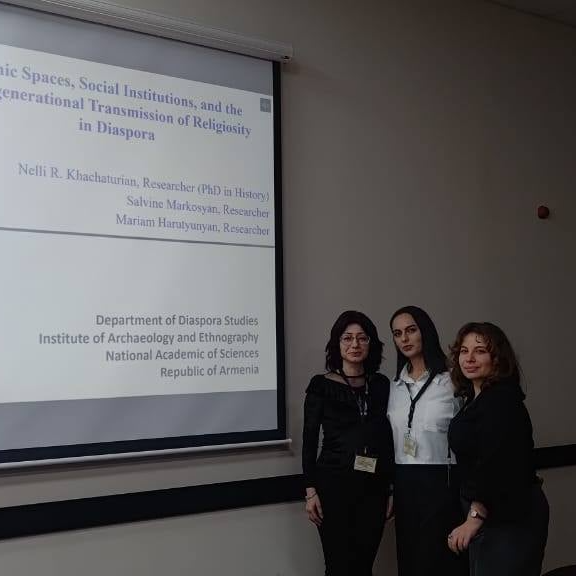
Researchers of the Institute of Archaeology and Ethnography Participated in the International Religion Studies Seminar in Blagoevgrad
On November 20–22, the International University Seminar on Balkan Studies and Specialisations at the Southwestern University “Neofit Rilski” in Blagoevgrad, Bulgaria, brought together scholars from various countries for a round-table discussion on “Religion and Religiosity – The Balkans and the Black Sea Region.” This was the 35th forum held in this format. The seminar brought together researchers from Armenia, Georgia, North Macedonia, Romania, Slovenia, Japan, Kosovo, and Bulgaria to discuss the role of religion across historical, cultural, social, and political contexts. The round-table was attended by researchers from the Department of Diaspora Studies of the Institute of Archaeology and Ethnography of the National Academy of Sciences of Armenia—PhD Nelli Khachatryan, Salvine Markosyan, and Mariam Harutyunyan. The participants presented a report titled “Ethnic Spaces, Social Institutions, and the Intergenerational Transmission of Religiosity in Diaspora.”
2025-11-27
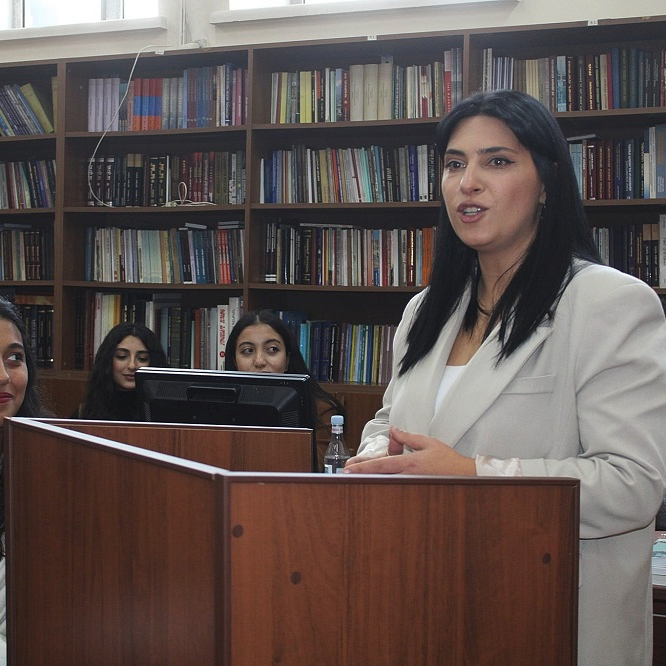
Presentation of the monograph “Cultural Policy in Soviet and Post-Soviet Armenia”
Recently, with the endorsement of the Academic Council of the Faculty of History at Yerevan State University (YSU), a 208-page monograph titled “Cultural Policy in Soviet and Post-Soviet Armenia”, authored by Haykuhi M. Muradyan, PhD in History and researcher at the Artsakh Cultural Heritage Studies Group of the Institute of Archaeology and Ethnography, was published. The work provides a comprehensive overview of the formation of Armenia’s cultural policy from 1920 to the present. On November 24, the book presentation took place at the library of YSU’s Faculty of History, attended by specialists interested in the topic, faculty members, students, and guests. The event was opened by Mkhitar Gabrielyan, Dean of the Faculty of History at YSU, who underscored the scholarly and practical significance of the monograph and congratulated the author. The book’s scientific editor, Professor Hamlet Petrosyan, Doctor of Historical Sciences, also delivered welcoming remarks, describing the monograph as a long-awaited and exceptional study. Gayane Kanatin, Scientific Director of the “SIREH” Cultural Heritage Research, Preservation, and Development Center and one of the initiators of the publication, emphasized in her address that the release of the monograph represents one of the key achievements of their organization. The publication was carried out within the framework of the pilot programs of the European Heritage Center and co-funded by the European Union and Europa Nostra. The importance of the book was further highlighted by Yulia Antonyan, Associate Professor at the Department of Cultural Studies of YSU’s Faculty of History, as well as Nzhdeh Yeranyan, PhD in History and Deputy Scientific Director of the History Museum of Armenia, both of whom congratulated the author on her valuable research contribution. The monograph was then presented by the author herself. The work includes an Introduction and the following chapters: “Definitions of Cultural Policy: “A Critical Review of Theoretical Approaches” “Cultural Policy in Soviet Armenia” “The New Conceptual Formation of Cultural Policy” “From Theory to Practice: Current Amendments to the RA Law on the Preservation and Use of Immovable Historical and Cultural Monuments and Historical Environment, and Their Semantic-Structural Problems”. At the end of the presentation, attendees posed questions to H. Muradyan and emphasized the importance of the monograph both for academic research and for the study of cultural policy formation processes.
2025-11-26
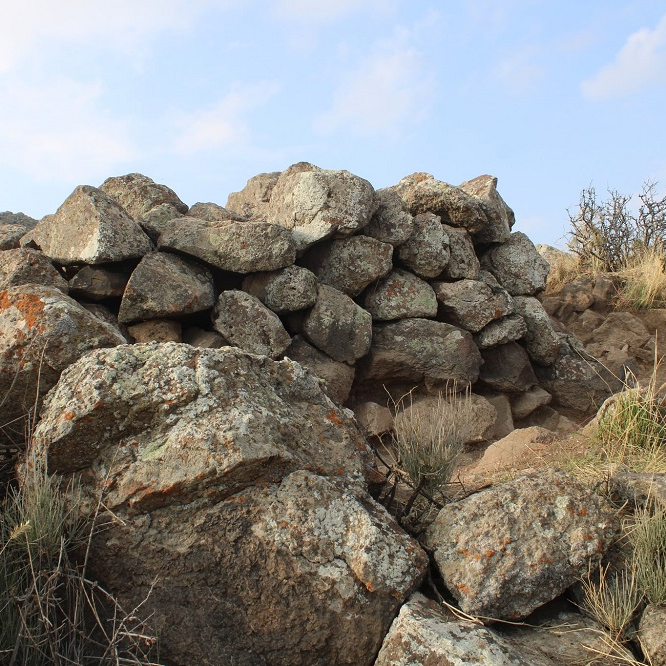
Archaeological excavations on the hills within the administrative territory of Aragatsavan village
These days, an expedition team from the Institute of Archaeology and Ethnography (IAE) of the National Academy of Sciences of the Republic of Armenia, led by Mariam Shakhmuradyan, Ph.D, a researcher of the Department of Early Archaeology, is conducting archaeological excavations on the hills within the administrative territory of Aragatsavan village, in the Talin district of Aragatsotn Province. On one of the hills, the team has uncovered the ritual section of an ancient fortress. The Talin district is rich in historical and archaeological sites, attesting to continuous human habitation and cultural activity over millennia. The most numerous remains belong to the pre-Christian period and include settlements, fortresses, megalithic towers, burial grounds, the so-called “desert kites,” as well as the ruins of various ritual and defensive structures. According to team member and archaeologist Levon Mkrtchyan, in the first millennia BC there existed a fortified settlement at the site, the spiritual and ritual sanctuary of which is currently being excavated. The sanctuary is a rectangular, solidly built stone structure with an area of about 16 square meters. Similar structures are known from the Armavir and Shirak Provinces. Excavations have revealed the walls of the structure, which in some sections are preserved to a height of more than 2 meters. They are constructed of roughly hewn basalt blocks. Additional tombs and dwellings have been preserved on the slopes and at the foot of the hill.
2025-11-18

Lecture dedicated to the Ygatu Digital Project, a collaborative initiative between IBM Research Brazil and the University of São Paulo
On November 5, an interesting lecture dedicated to the Ygatu Digital Project, a collaborative initiative between IBM Research Brazil and the University of São Paulo, was held at the library of the Institute of Archaeology and Ethnography of the National Academy of Sciences of the Republic of Armenia (IAE NAS RA). At the beginning of the event, attention was drawn to the issue of preserving endangered languages of indigenous peoples, within which the preservation of the Artsakh dialect was also emphasized as an essential component of intangible cultural heritage. The lecture, which was the second in the series “Crisis and Memory: Laboratory of Digital Oral Histories,” was delivered by Dr. Claudio Pinhanez, Professor and Deputy Director of the Center for Artificial Intelligence at the University of São Paulo, and Principal Researcher at IBM Research Brazil. The audience included staff members of various IAE departments, students, and others interested in the topic. The lecture was conducted in English with simultaneous interpretation into Armenian. The speaker noted that one of their main goals is the preservation of Brazil’s forests—a mission historically carried out by local indigenous communities, who continue traditional tree-planting and environmental practices. He presented several digital projects implemented among indigenous communities in South America, particularly in the Amazon region, aimed at fostering community engagement and preserving cultural identity. Dr. Pinhanez also introduced a joint project of IBM Research and the University of São Paulo, which he has led since 2022. The project applies digital and artificial intelligence tools, such as spell checkers, next-word prediction systems, and digital dictionaries, to promote the use of endangered indigenous languages. The initiative focuses on the documentation and revitalization of the languages of Brazil’s indigenous peoples. Through photographs and video materials, Dr. Pinhanez showcased ongoing work with the Baré people of the Amazon, including the creation of two digital learning centers to be launched in July 2025. The uninterrupted operation of these centers will be ensured through the use of solar energy. The event concluded with a lively question-and-answer session and open discussion.
2025-11-06

Sona Nersisyan’s Research Visit to the Republic of Argentina
In September–October of this year, Sona Nersisyan, Ph.D., Senior Researcher at the Department of Diaspora Studies of the Institute of Archaeology and Ethnography of the National Academy of Sciences of the Republic of Armenia, undertook a research trip to the Argentine Republic to conduct field investigations. The fieldwork, carried out using a range of research methods, encompassed the cities of Buenos Aires, Córdoba, and Villa Carlos Paz, as well as several of their eastern and suburban settlements. Within the framework of the trip, meetings and in-depth interviews were organized with the heads of community structures, representatives of Armenological departments, as well as individuals both involved and not involved in community life. In addition, documentation of Armenian monuments, memorials, and community events was conducted.
2025-11-04

The defense of Arsen Harutyunyan’s doctoral dissertation on the topic “Medieval Tatev and Its Written Cultural Heritage” took place at the Institute of Archaeology and Ethnography
On October 30, in the reading hall of the Institute of Archaeology and Ethnography of the National Academy of Sciences of the Republic of Armenia (IAE), the session of the Specialized Council 007 “Archaeology and Ethnography” operating under the Higher Attestation Commission (HAC) attached to the Institute of Archaeology and Ethnography took place. During the session, Arsen Harutyunyan, Ph.D., Head of the Department of Epigraphy of the IAE, defended his doctoral dissertation entitled “Medieval Tatev and Its Written Cultural Heritage.” The event was attended by Arsen Bobokhyan, Director of the Institute, staff members from various departments, as well as scholars and students interested in the topic. The dissertation topic had been approved by the Academic Council of the IAE of the NAS RA. The scientific secretary of the Specialized Council was Yervand Grekyan, Doctor of Historical Sciences. The official opponents were Doctors of Historical Sciences, Professors Karen Matevosyan, Hamlet Petrosyan, and Arman Yeghiazaryan. The leading organization was Yerevan State University. The dissertation of Arsen Harutyunyan is dedicated to Tatev Monastery — a major spiritual and cultural center of Syunik — as well as to the historical description of the nearby monastic villages and the comprehensive study of their written heritage. The work consists of an introduction, the chapters “The Tatev Monastic Complex and Its Rock Inscriptions,” “Tatev Monastery as a Center of Script and Scholarship,” “The Historical and Cultural Heritage of the Ancient Monastic Villages of the Vorotan Gorge,” “Small Churches Adjacent to Tatev Monastery,” “The Revival of the Eremitic Movement in Syunik,” and conclusions. The chairman of the Specialized Council, Doctor of Historical Sciences, Corresponding Member of the National Academy of Sciences of Armenia, Pavel Avetisyan, introduced the candidate and emphasized the importance of the research conducted. The Head of the Department of Archaeology and Ethnography of the Faculty of History at Yerevan State University, Doctor of Historical Sciences, Professor Hayk Avetisyan, also shared his observations regarding the scientific value and relevance of the dissertation. Following the presentation of the work, questions, comments, and suggestions were raised, after which the official opponents delivered their speeches. With the recommendation to take the noted comments into account, the dissertation was unanimously approved, and Arsen Harutyunyan was awarded the degree of Doctor of Historical Sciences.
2025-10-30
